“Will we make it this month?”
The answer is a feeling, based on today’s balance and on what the director happens to remember.
A haulage company does not run out of money at the end of a quarter: it runs out on the Tuesday of week six, between payroll and a client on ninety-day terms. The product starts from the real bank statement, spreads the next thirteen weeks, and turns the difficult week into a queue of payments to prepare.
The answer is a feeling, based on today’s balance and on what the director happens to remember.
The statement arrives at month end and the accountant ticks lines by hand, looking for which invoice each one matches.
It was in a payment run prepared last week, and it went out again in this week’s. Nobody saw it.
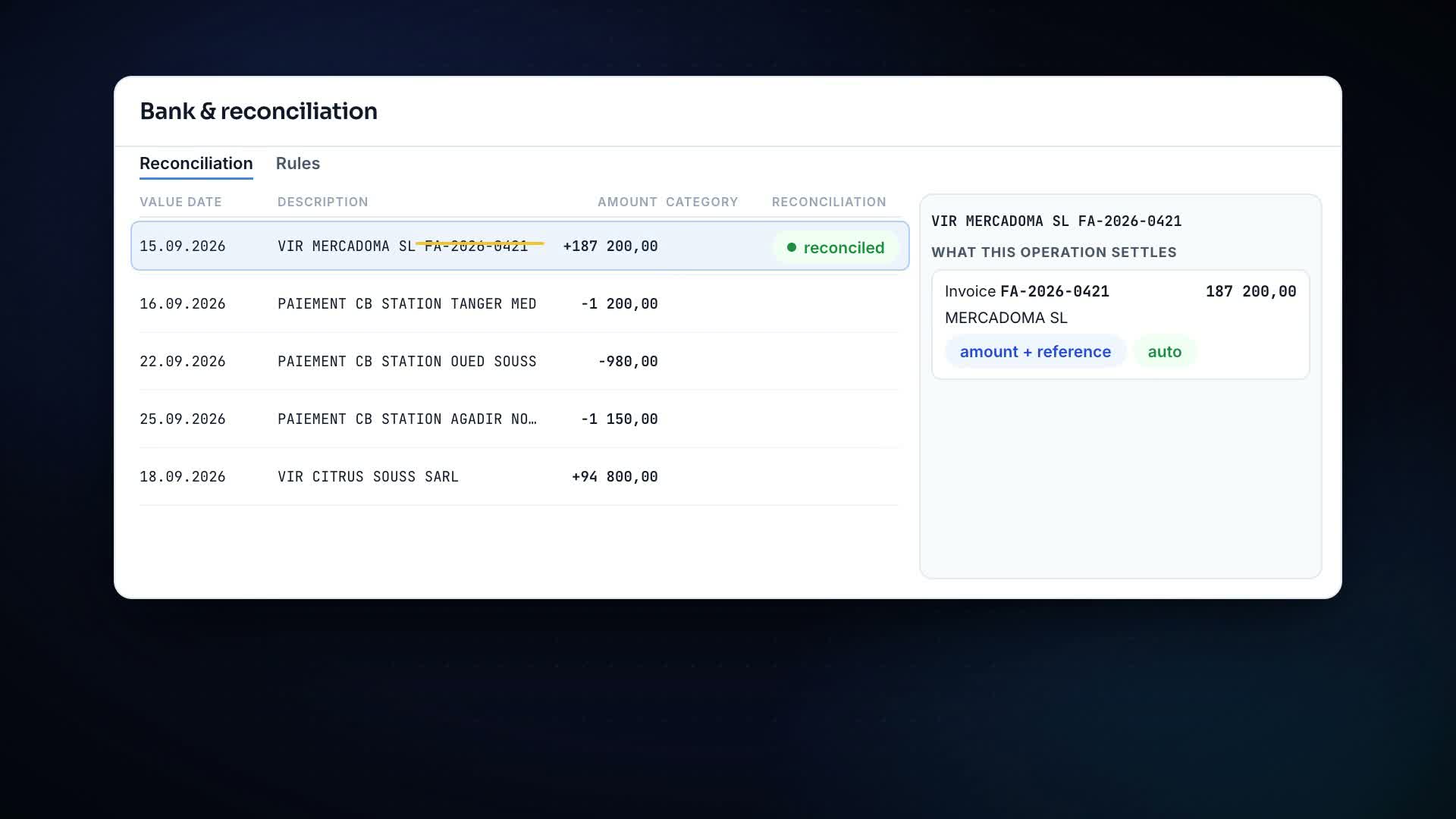
CSV or Excel, columns recognised automatically. Moroccan banks write the direction of an operation in three different ways — two debit/credit columns, a signed amount, or an amount plus a D/C letter — and all three are accepted.
The detail that matters. When no sign can be identified, the product refuses instead of guessing: a minus silently flipped costs more than an import to redo.
Linking a statement line to an invoice creates the payment entry in the very ledger the forecast subtracts its expectation from. That is why the ninety-day position is identical before the import and after the reconciliation.
The detail that matters. Categorisation rules classify recurring costs on their own (“AFRIQUIA” → fuel); attaching money to a document stays a human decision.
Money sitting on the account that no document explains is shown in plain sight: while it is not zero, the forecast may be counting twice. The product displays the limits of its own accuracy.
The detail that matters. The “closing balance printed by the bank” field is optional and yet the most useful: if our computed balance differs from it, a line is missing from the statement.
The same three terms — balance, expected receipts, upcoming payments — spread over thirteen weeks. The sum of the weeks equals, to the centime, the total on the bank screen: no new arithmetic is introduced.
The detail that matters. The base of the bars is not zero but YOUR floor — the cushion below which the company considers itself in trouble. It defaults to zero: the product does not invent your buffer.
The low week does not display “minus two hundred and six thousand” but the salaries, the social contributions and the client invoice that compose it. A forecast you cannot take apart is a forecast nobody believes.
The detail that matters. Scenarios are questions, not statements: “the main debtor pays a month late”, “diesel +12 %” — applied at read time, without writing a single row of data.
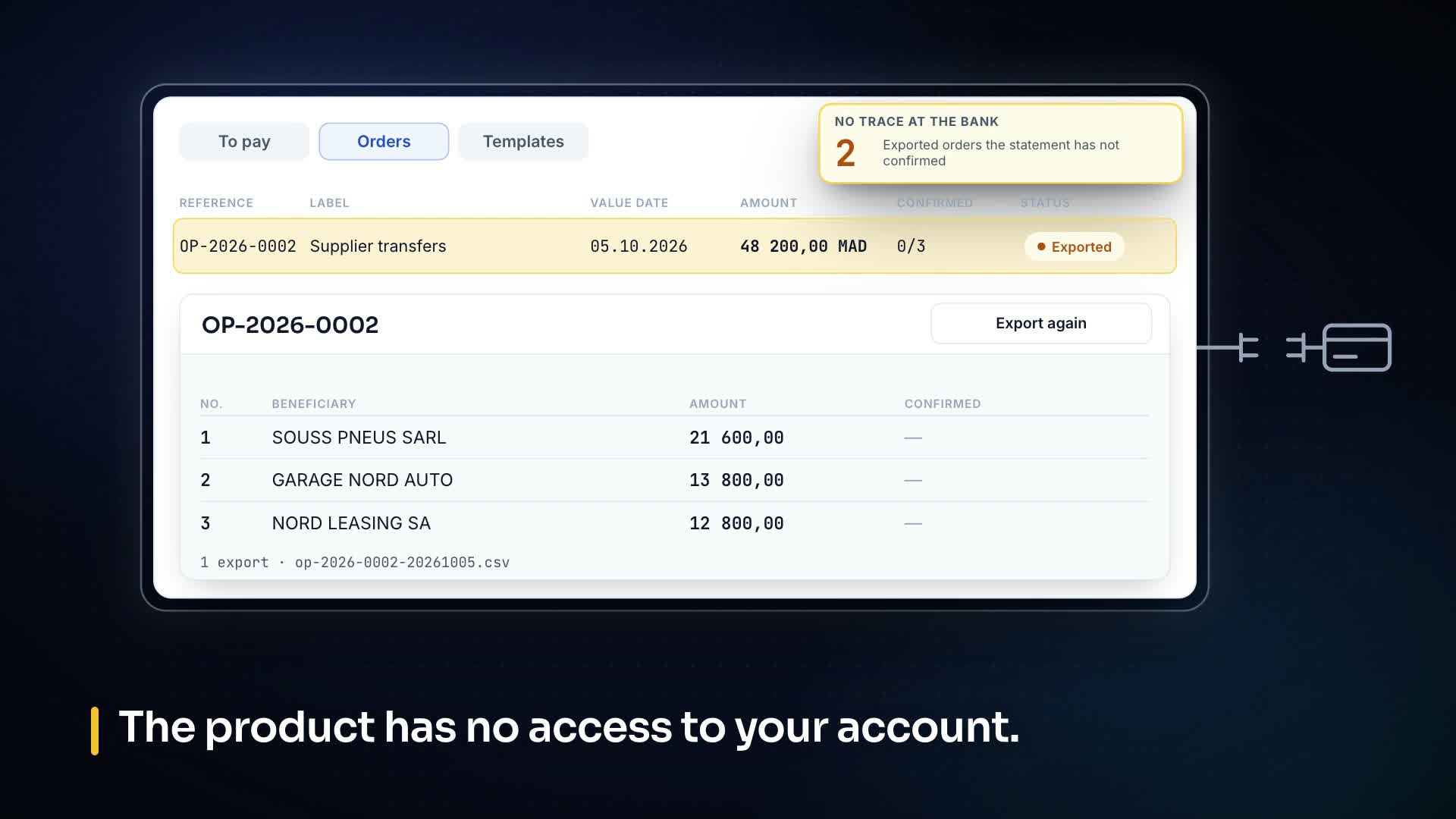
The queue gathers supplier invoices and commitments falling due; you tick, the order is created, and the export produces the CSV file your online bank expects. Every bank has its format: the built-in template covers the main networks, the editor lets you build your own.
The detail that matters. A line without valid bank details does not enter the file: it stays visible as “blocked” rather than getting the whole batch rejected by the bank.
| Week | Receipts | Payments | Closing balance |
|---|---|---|---|
| W4 · 15 → 21 Sept | + 268,000 | − 214,500 | 512,300 |
| W5 · 22 → 28 Sept | + 96,400 | − 243,900 | 364,800 |
| W6 · 29 Sept → 5 Oct | + 58,200 | − 206,400 | 216,600 |
| W7 · 6 → 12 Oct | + 311,500 | − 128,700 | 399,400 |
It has no access to your account. Neither creating an order, nor approving it, nor exporting it moves a dirham: you upload the file to your bank. The worst a mistake can produce is one extra line in a file you see before sending.
What remains payable is the open balance minus what another order has already reserved. The same invoice cannot go out twice — not because someone remembered, but because the arithmetic forbids it.
Import deduplication counts real occurrences instead of deleting what “looks similar”. Re-importing the same file adds nothing; two visits to the same station on the same day stay two lines.
A wrong import is rolled back as a batch, together with the payments it created. Un-matching is done with a counter-entry: the ledger stays complete and the expectation returns to its place.
The three modules switch on separately. Bank reconciliation alone already makes sense; the forecast takes on its own once supplier invoices are entered.
No, and that is deliberate. We import the export your online bank already produces, and we hand back a file that you upload yourself. No access to your accounts is requested.
It is incomplete, and it says so: the unreconciled amount and the due dates beyond the horizon are displayed next to the curve. That is the difference between a tool that shows its limits and a spreadsheet that shows certainty.
Yes: a scenario applies corrections at read time — a client paying later, a cost item rising — without touching your data. Frozen versions then let you measure how accurate your past forecasts actually were.
 1:55Episode 29What do we pay on Monday, and how do you prepare it in minutes?
 1:59Episode 27How do you reconcile the bank statement in minutes, not hours?
 1:56Episode 26How many bills of exchange are sitting in your safe, and for how much?
 1:52Episode 23How do you go from a finished trip to an invoice with no gap in the numbering?
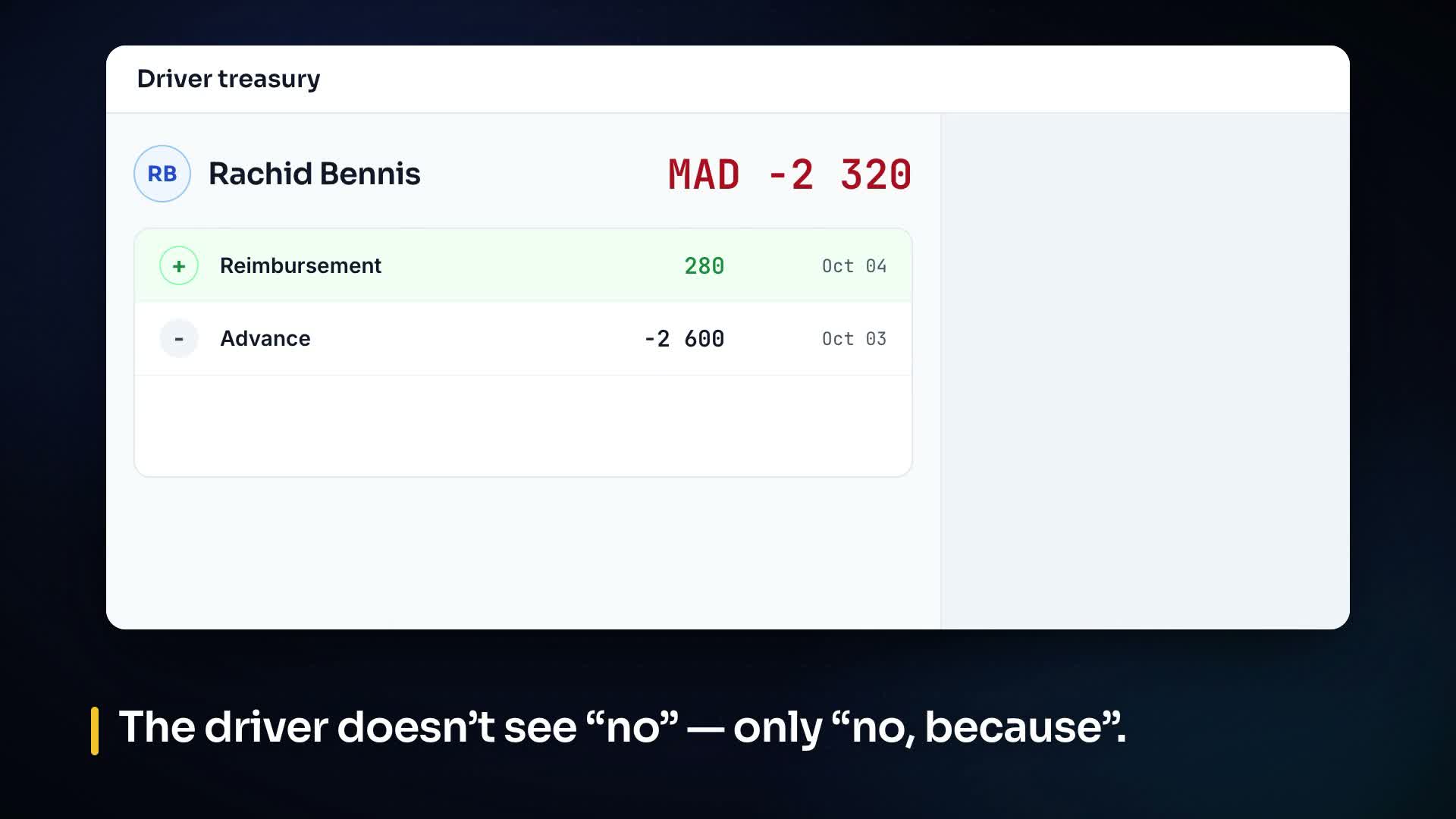 1:40Episode 24How do you keep driver advances and expense claims without a notebook?
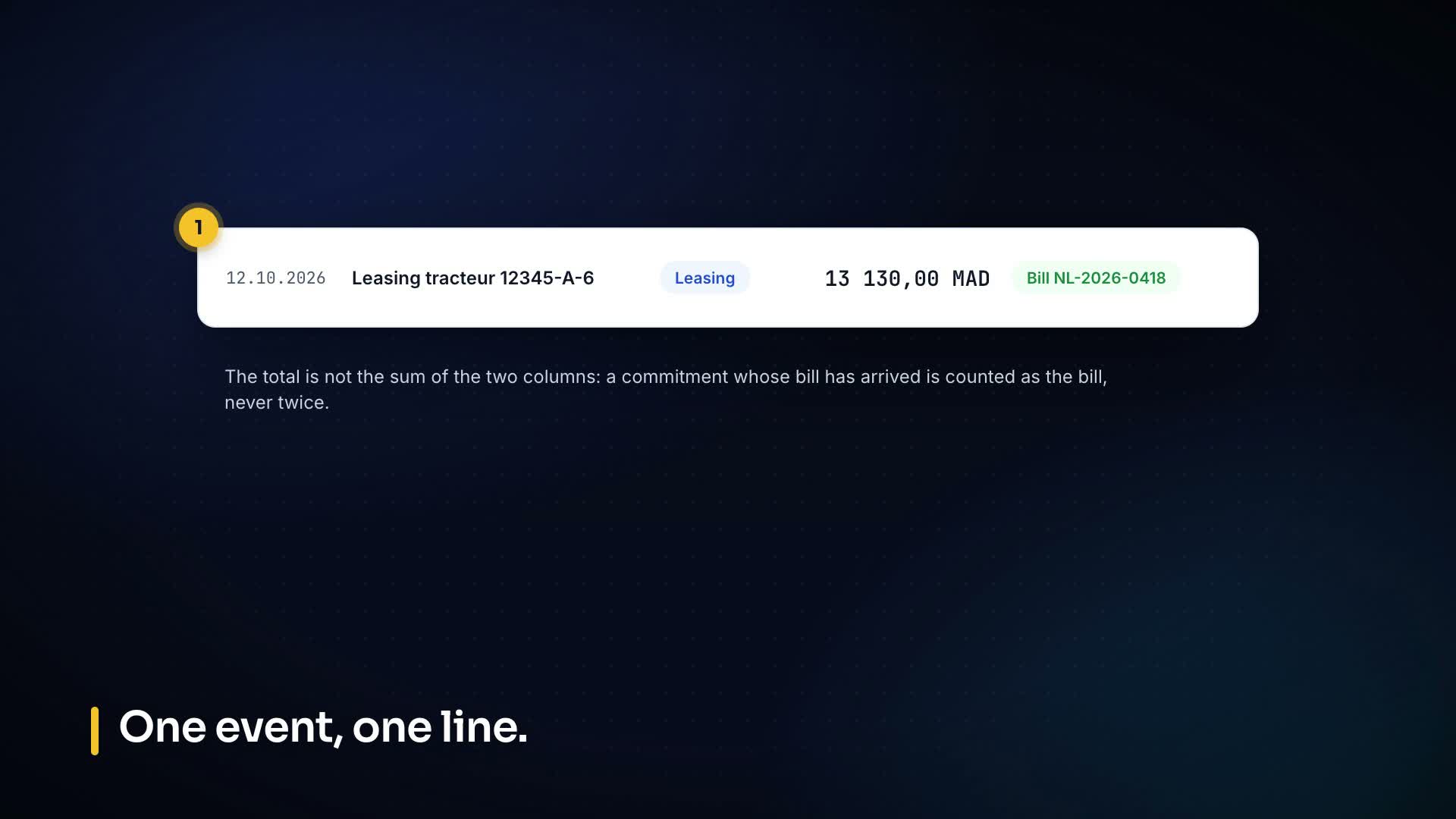 1:41Episode 25How much cash will you need to pay out over the next thirteen weeks, and when?
Create the account, tick your modules, add the trucks — the first mission leaves today.