The invoice goes out a week later
By the time you find the agreed price, the signed form and the real mileage, Monday’s delivery is invoiced the following Monday. Times a hundred missions, that is a month of cash.
A transport invoice is built from things that already happened: a delivered mission, an accepted order form, a signed CMR. The product assembles the document, allocates the number at the right moment, prints the exemption when it applies — then follows the money to the payment, including when it arrives as a bill of exchange at ninety days.
By the time you find the agreed price, the signed form and the real mileage, Monday’s delivery is invoiced the following Monday. Times a hundred missions, that is a month of cash.
The list of unpaid invoices is rebuilt by hand, at month end, from the bank statement and the accountant’s memory.
The client paid with a bill at maturity. Nobody knows how many there are, nor which one must go to the bank this week.
You pick the missions to bill — several on one invoice if the client asks — and the document builds: route, agreed price, client tax identifier, payment terms taken from their card.
The detail that matters. Terms come from the client register but stay editable on the invoice: a special case should not force you to change the general rule.
A draft has no number at all. The series is yearly and continuous — continuous numbering is a requirement in Morocco, not a convenience.
The detail that matters. The year comes from the issue date: an invoice issued on 2 January does not fall by accident into last year’s series.
The rate lives on the line, the regime on the document. For international transport the product proposes the article 92-35 exemption and prints the mention: an exporter does not have to remember the wording.
The detail that matters. The proposal is based on the mission type; you validate it. Software that decides a tax regime on its own makes its customer carry its mistake.
Forty thousand received out of a hundred and twenty-six: a line is added, the balance is recalculated, the invoice stays open. Cash, transfer, cheque, bill of exchange — the method is recorded.
The detail that matters. The ledger only grows. Nothing is erased retroactively: a correction is one more entry, with its author and date.
The “N days late” status is computed from the client’s payment terms, and the reminder becomes an alert at the threshold you chose. Get paid, and the alert closes by itself.
The detail that matters. The client card shows turnover and outstanding amounts computed from invoices — two columns nobody types by hand.
Paper received from a client enters the portfolio with its maturity. One bill can cover three invoices, two bills can cover one: that is what really happens, and the only way the figures add up.
The detail that matters. A bill does not pay the invoice: it moves the date and changes the instrument. The invoice stops being overdue without becoming paid — it becomes paid when the paper is actually honoured.
Taken to the bank for discounting, the paper advances you money, the bank keeps its charge and leaves you the risk. The product treats it as such: no second inflow at maturity, a visible contingent liability, and the twelve-month cost of the portfolio on display.
The detail that matters. A bill returned unpaid reopens the receivable through a counter-entry and records the fee. Nothing is quietly cleaned up.
| No. | Client | VAT | Total incl. tax | Status |
|---|---|---|---|---|
| FA-2026-0412 | COSUMAR | VAT | 126,480 | 32 days late |
| FA-2026-0409 | CITRUS SOUSS | EXEMPT | 94,800 | 18 days late |
| FA-2026-0421 | MERCADOMA SL | EXEMPT | 187,200 | Sent |
| AV-2026-0007 | MARJANE | VAT | −6,480 | Credit note |
The number is allocated atomically at issuance. Two people approving at the same instant do not get the same number, and a deleted draft consumes none.
The content no longer changes. Correction goes through a credit note, a separate document with its own series — what your accountant would do, and what an audit will ask for.
Sales can issue an invoice but cannot record its payment. These are two different permissions, enforced on screen and on the server alike.
Recording the same bill from the same party twice would count the money twice in the forecast. The product refuses the duplicate instead of letting the cash position lie.
The bills module is optional: if your clients pay by transfer, do not switch it on. The price only counts what is enabled.
No, and we do not try. The product covers the operating cycle — documents, receivables, payables, bank — and provides your accountant with PDF invoices and Excel reports. The bookkeeping entries stay with them.
Yes, with the detail per mission. That is the normal case for a regular client: one invoice per period, every trip identified, every container named.
The currency belongs to the document. The product refuses to add dirhams and euros into one total: it shows the two sums separately instead of inventing a rate.
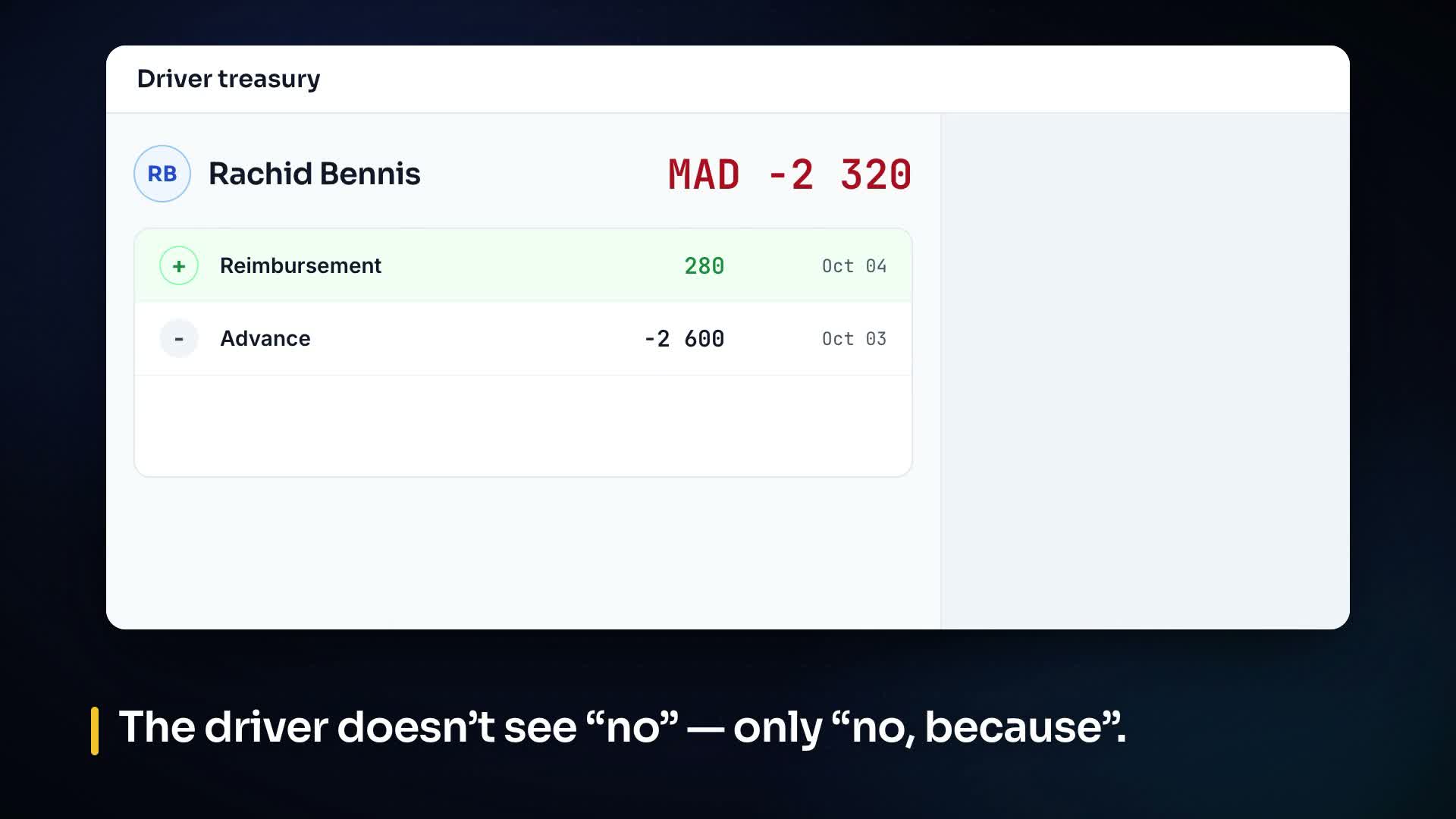 1:40Episode 24How do you keep driver advances and expense claims without a notebook?
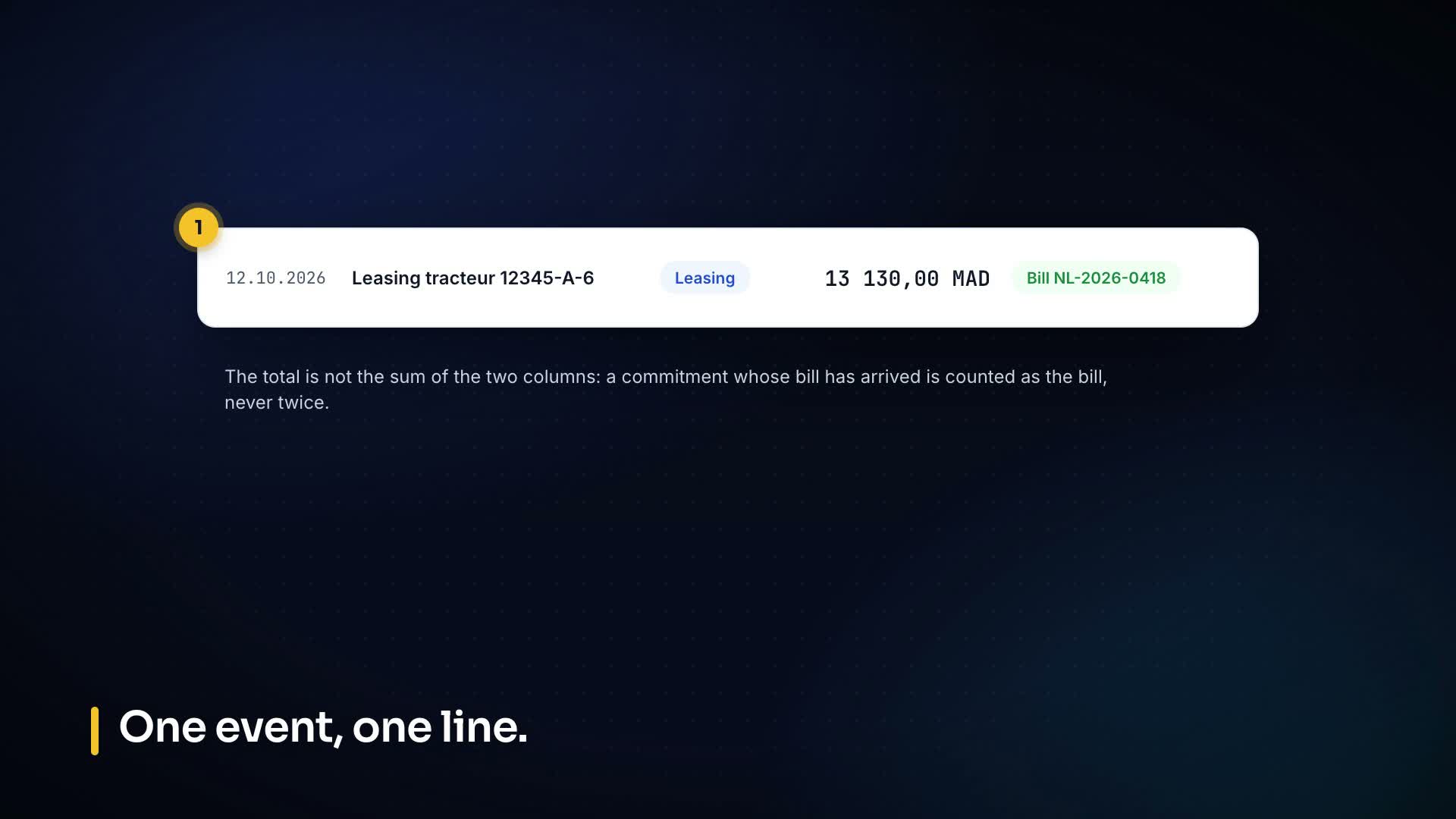 1:41Episode 25How much cash will you need to pay out over the next thirteen weeks, and when?
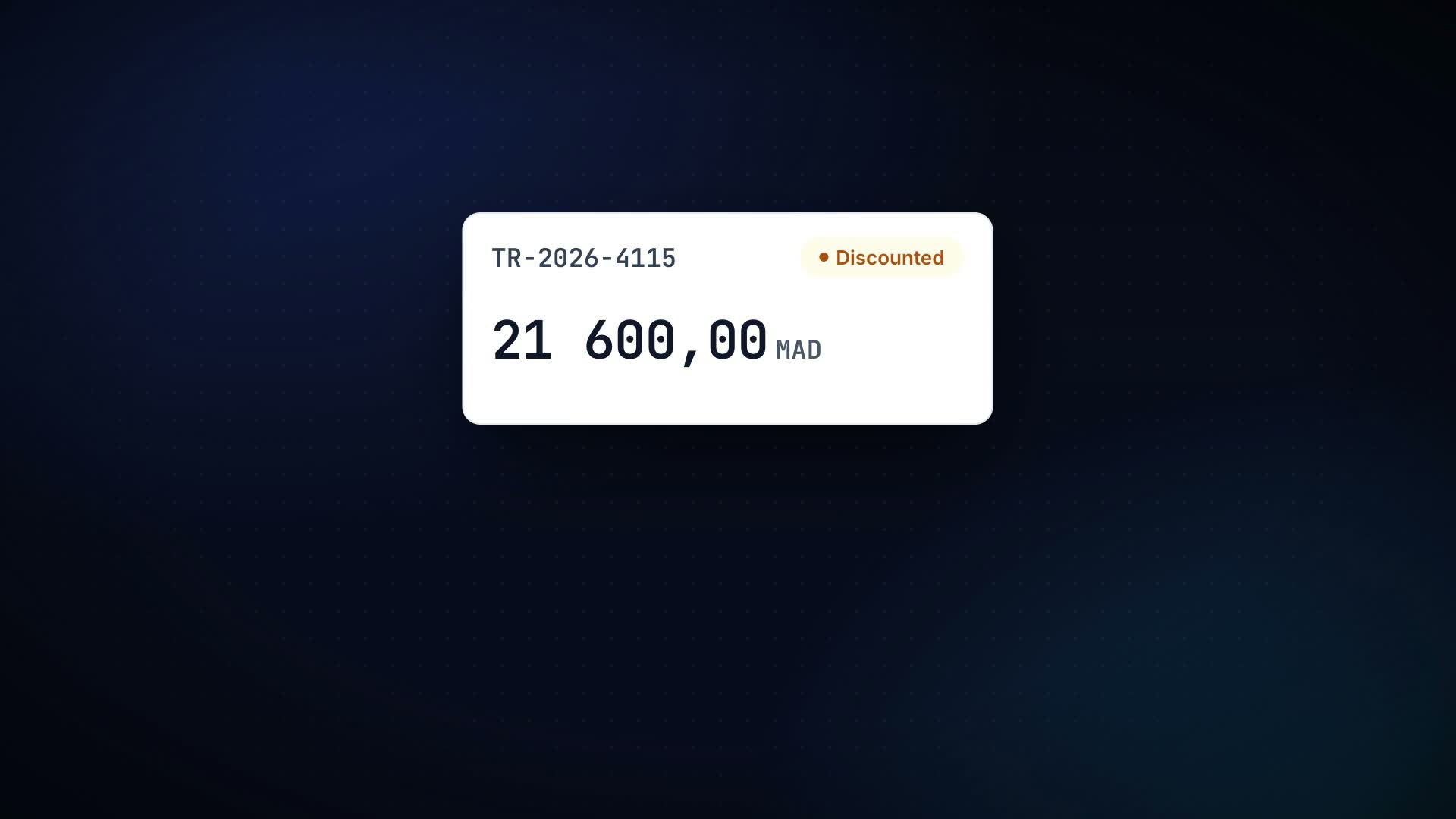 1:56Episode 26How many bills of exchange are sitting in your safe, and for how much?
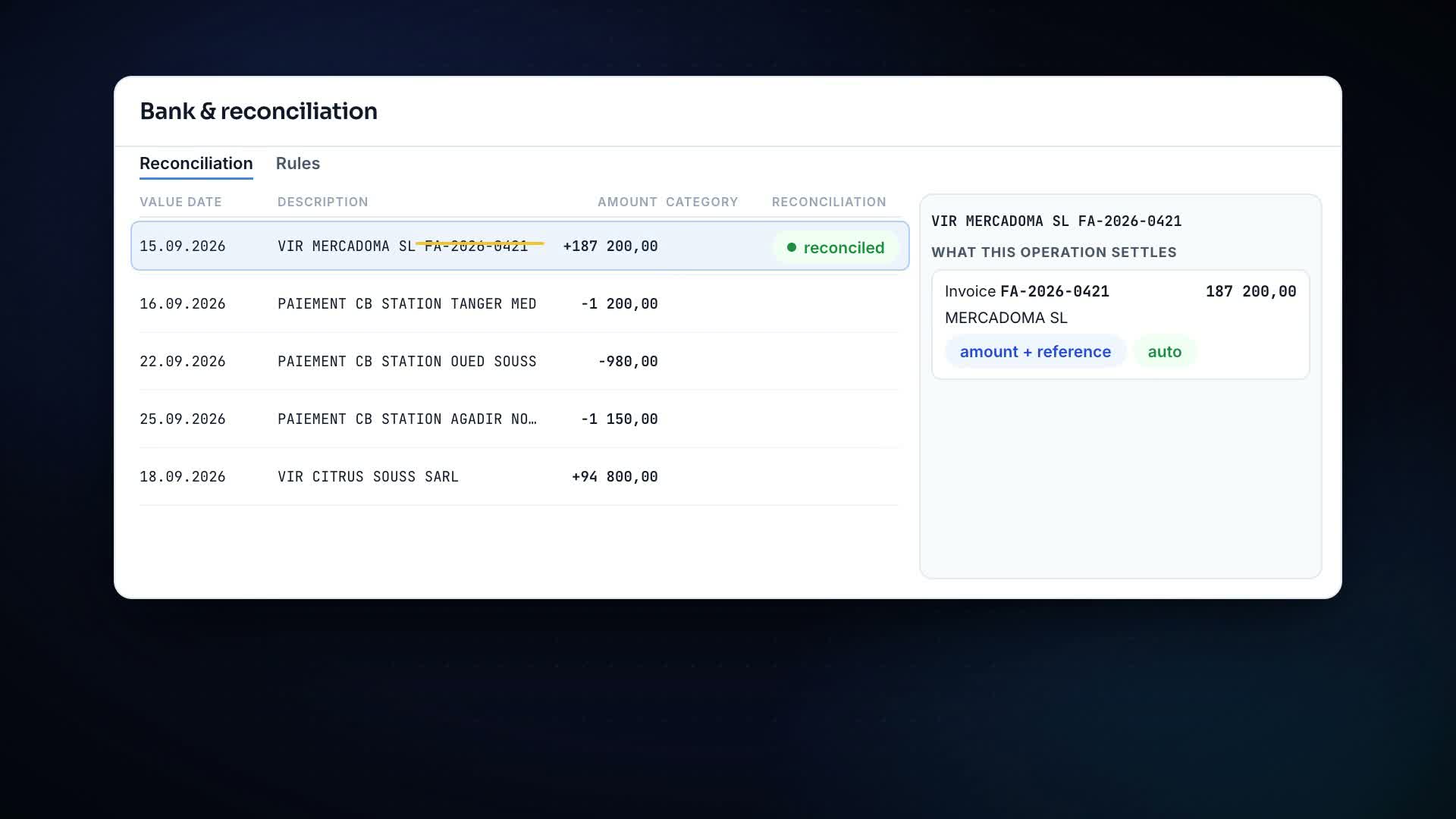 1:59Episode 27How do you reconcile the bank statement in minutes, not hours?
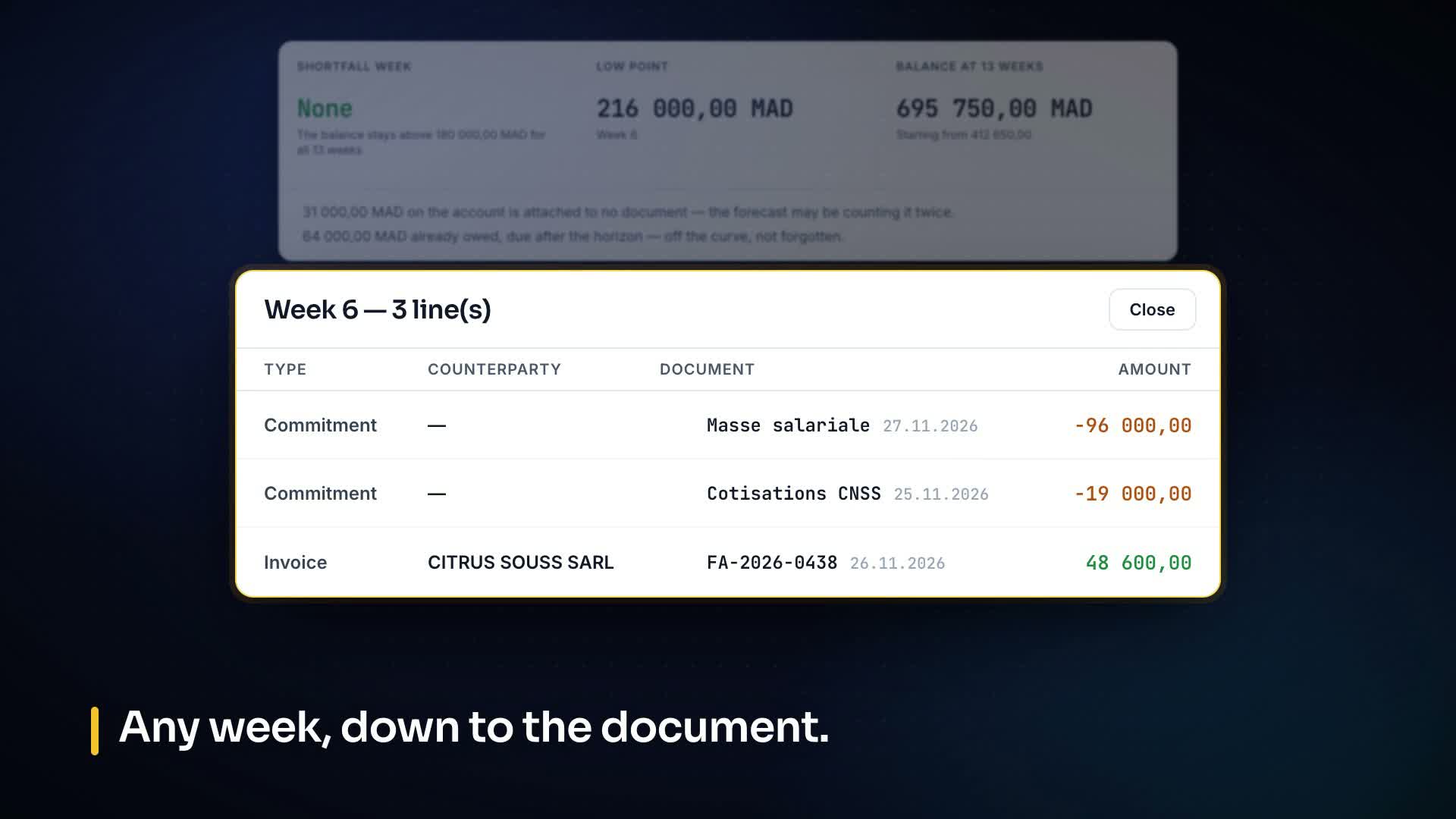 1:59Episode 28Which week will the cash run short, and can you see it a month and a half ahead?
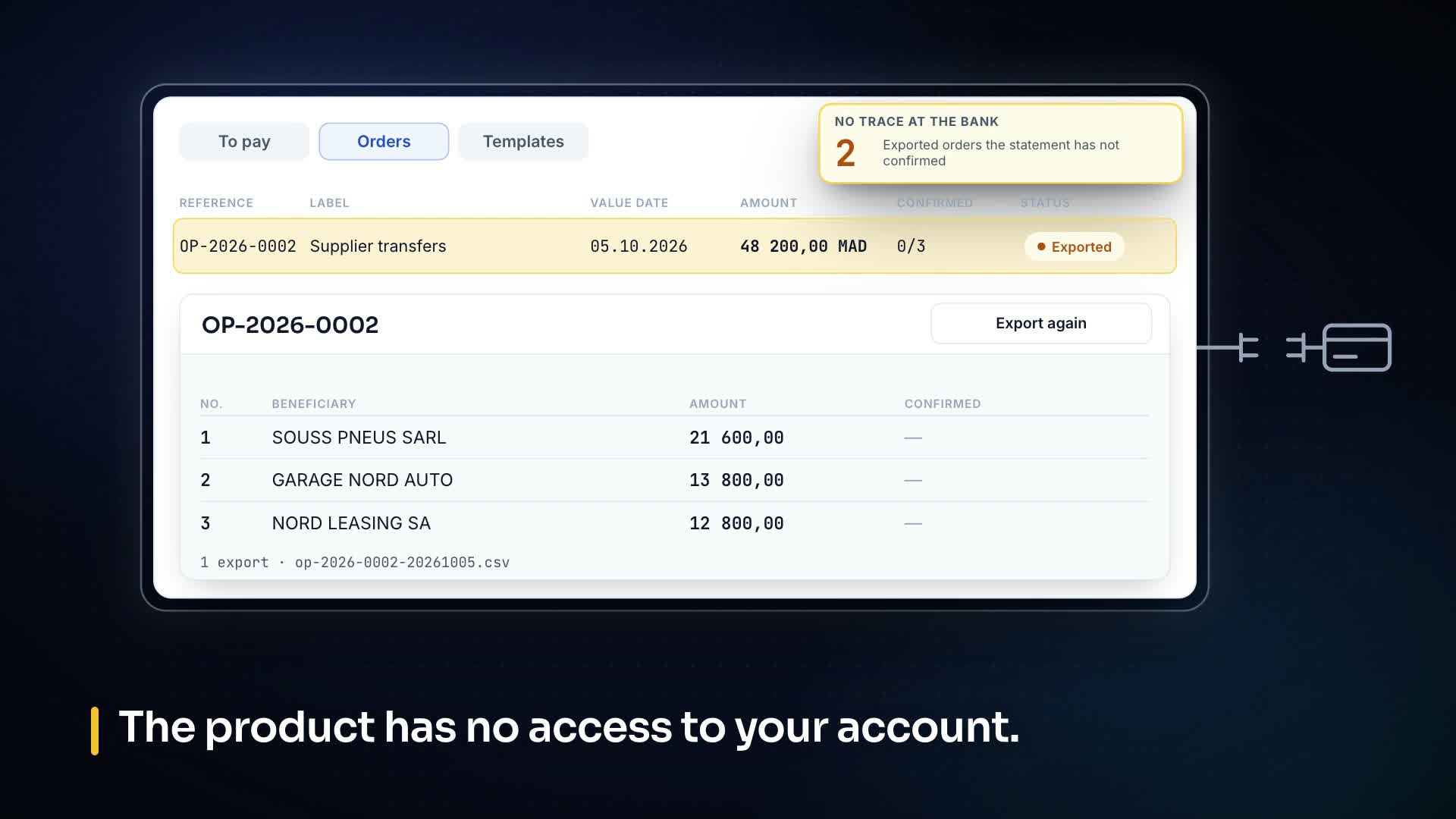 1:55Episode 29What do we pay on Monday, and how do you prepare it in minutes?
Create the account, tick your modules, add the trucks — the first mission leaves today.