The oil change happens when someone remembers it
The logbook is in the glovebox, the due date is in the mechanic’s head, and the delay is paid for in engine — once, very expensively.
An immobilised truck costs twice: the repair, and the trip it did not make. The module keeps repair orders, maintenance plans by kilometre and by date, tyres, and the figure almost nobody can produce — how many hours your fleet spent standing still, truck by truck.
The logbook is in the glovebox, the due date is in the mechanic’s head, and the delay is paid for in engine — once, very expensively.
The immobilisation is written nowhere: not its duration, not its cost, not the trip it made fall through. It gets told, it never gets counted.
Garage invoices sleep in the supplier folder, never attached to the vehicle that caused them. So the most expensive truck in the fleet looks like all the others.
Repair, oil change, inspection, tyres: an order opens with or without immobilisation. With it, the vehicle moves to «Workshop» and leaves the available list — the dispatcher can no longer assign it by accident.
The detail that matters. The opening and the status change are written in a single transaction. On closing, the truck only becomes available again if no other order is still open on it: two parallel repairs do not release each other.
The lines of an order carry labour and parts as facts, without prices. The amount comes from the garage invoice attached to the vehicle; the «Fleet» view accumulates those invoices, truck by truck.
The detail that matters. It is the margin doctrine applied to the workshop: a cost is never entered twice. A price typed on an order line would be a second truth — and the day it differs from the invoice, that is the one people would read.
A plan — every 30 000 km, every six months, or both — produces a next service recomputed from the orders actually closed and from the truck’s real odometer.
The detail that matters. With no starting point the screen shows «—» and says what is missing. It does not invent a date out of nothing: a wrong due date is worse than no due date, because it gets believed.
Every tyre has its card: brand, size, position on the vehicle, mounting date, accumulated mileage. Rotation, wear, damage, sale — a removal always says why.
The detail that matters. A tyre’s mileage follows the odometer of the vehicle it is mounted on: the same odometer as fuel and the workshop, never a second one kept aside.
The «Fleet» view gives, per vehicle, the hours standing still over the last 90 days, the number of orders and the accumulated invoice cost. That is the figure that answers «should we keep this truck».
The detail that matters. The status history is written by the product’s core, not by the module: the day you switch maintenance on, the previous months of immobilisation are already measurable. We do not sell you a counter that starts at zero.
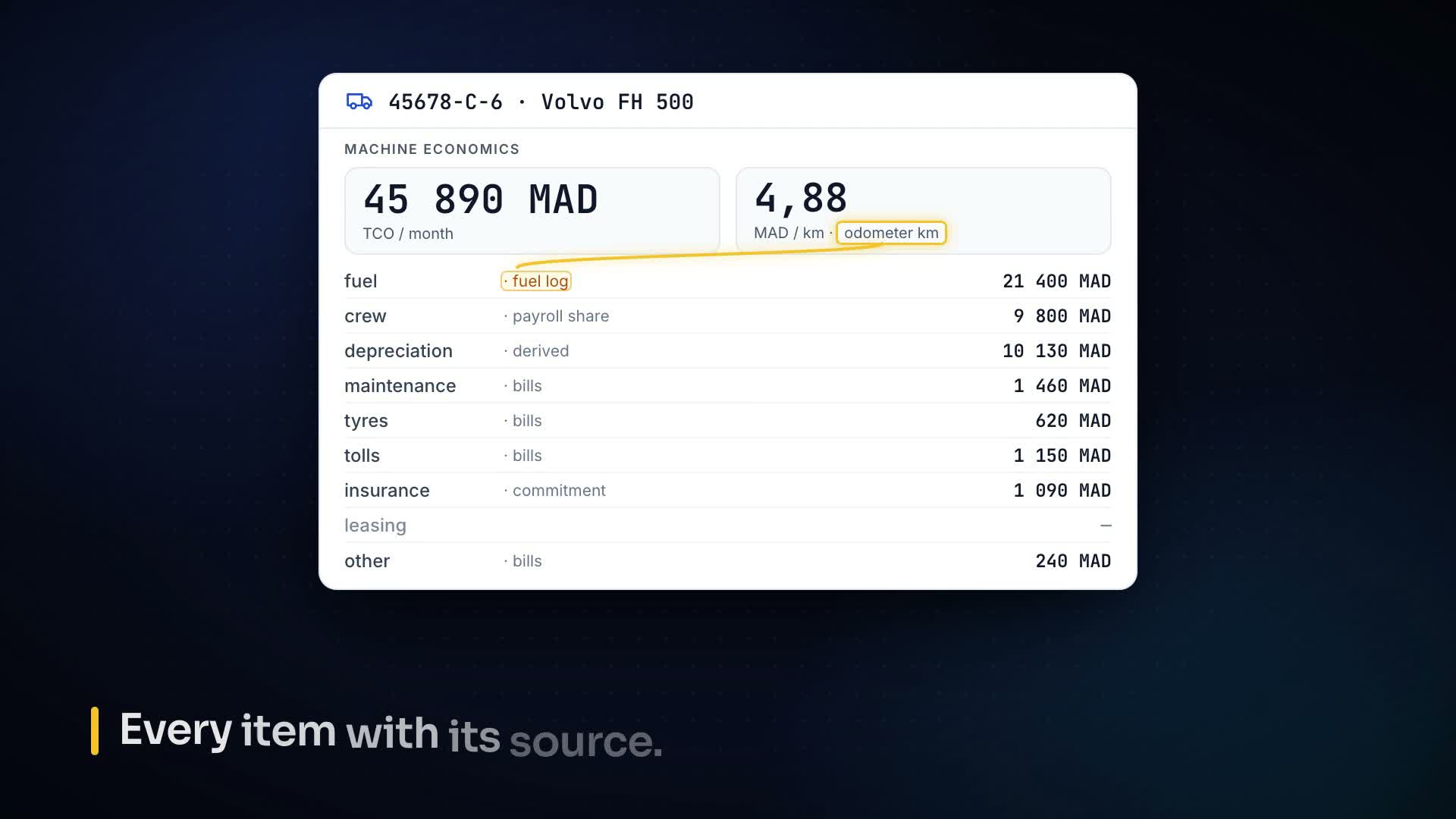
The tractor’s card on the Fleet screen adds it all up: the bills bound to the machine — insurance, repairs, tyres —, the amortization derived from four parameters entered once, and the cost per kilometre. Every figure names its source: the fuel journal’s odometer, the mission legs, or an honest dash when nothing was recorded.
The detail that matters. The amortization posts no bookkeeping entries: it is recomputed on read from the price, the life and the residual value — correct a parameter and the figure follows, and a written-off machine shows a deliberate zero. Binding a bill to the machine moves not a centime of the per-trip margins: it is a third reading of the same documents, not a correction of the first two.
| Vehicle | Type | Title | Opened | Odometer | Invoice | Status |
|---|---|---|---|---|---|---|
| 12345-A-6 | Oil change | Service 30 000 + filters | 02/09 | 412 300 | GARAGE ATLAS · 2 400 MAD | Open |
| 45678-C-6 | Repair | Clutch | 28/08 | — | pending | Immobilised |
| 23456-B-6 | Inspection | Roadworthiness test | 21/08 | 298 110 | CT AGADIR · 650 MAD | Closed |
| 44556-R-6 | Tyres | Axle 2 rotation | 19/08 | — | — | Closed |
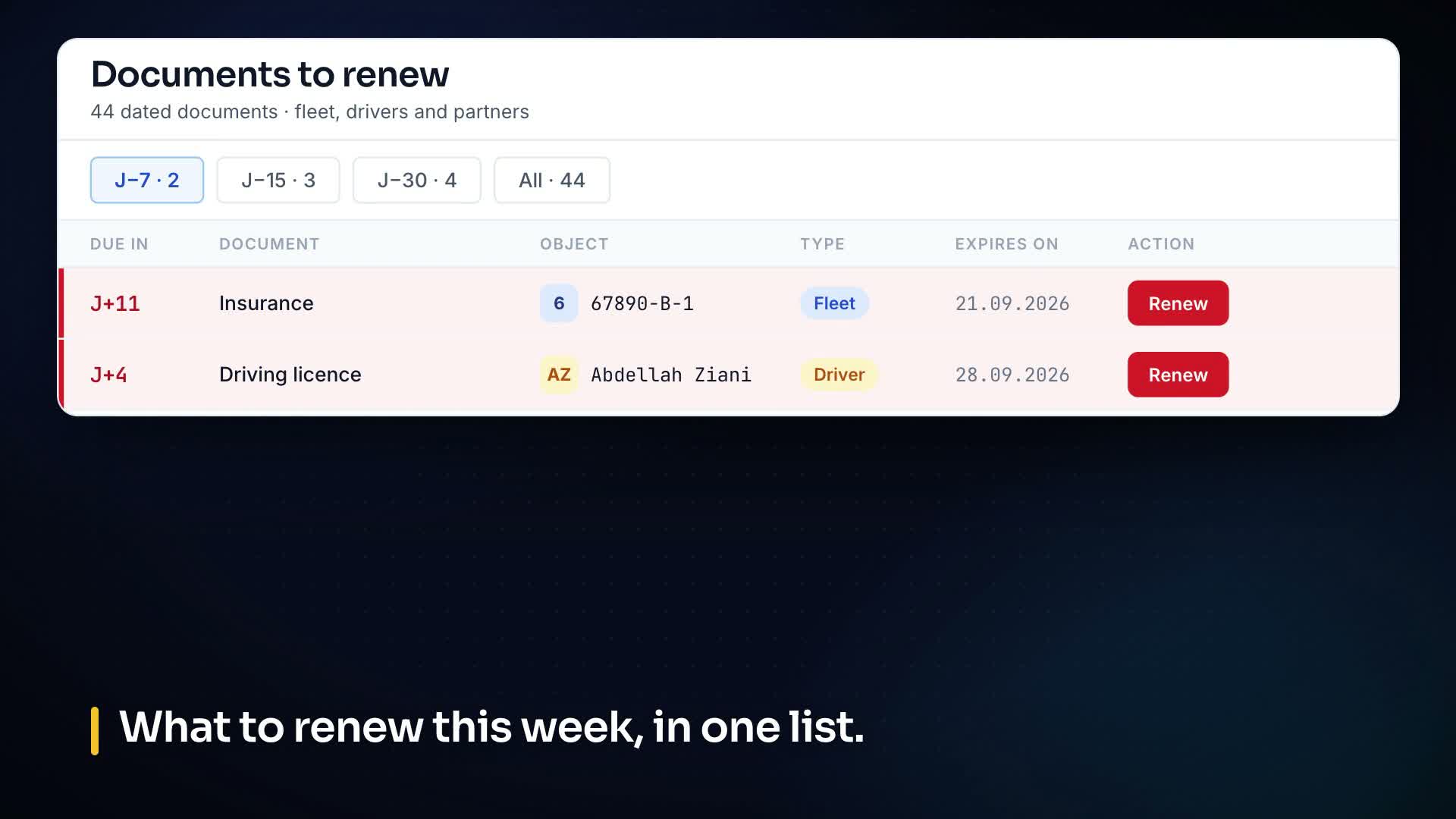
Assignment refuses it and says why, exactly as for an expired document. The available list is the truth, not a list that is up to date «in principle».
Closing one repair does not make the truck available while another order is still open on it. That is the protection every spreadsheet lacks: you tick one box and forget the other.
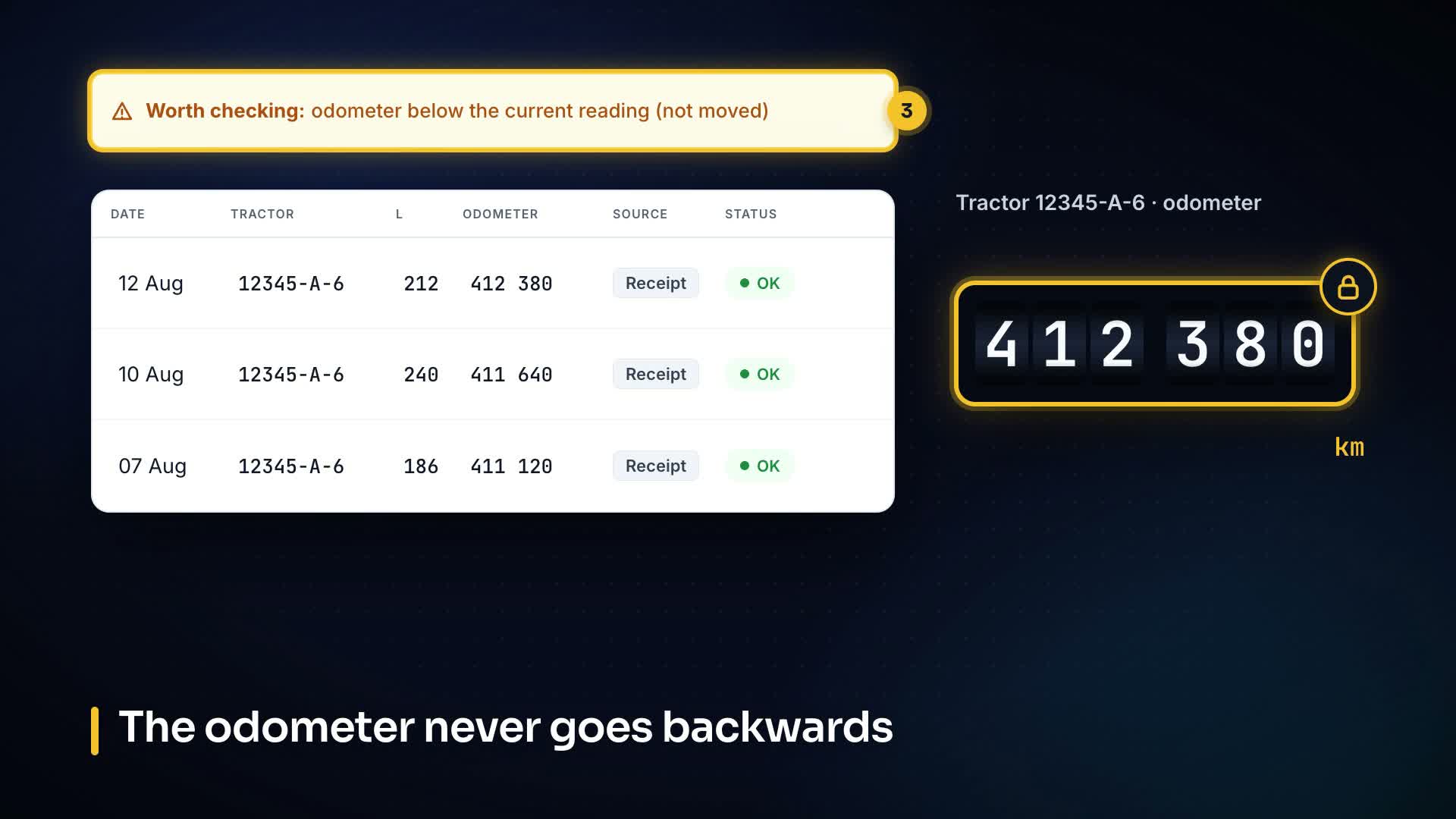
A workshop visit moves the same counter as a fill-up, and always upwards. There are never two mileages for one tractor.
A plan with no starting point shows «—» with the reason, rather than a due date computed out of nothing. The product would rather admit it does not know.
A driver request from their phone — «something is knocking at the front right» — turned into an order, and a parts stock with quantities, are announced for the next version. They are additions: orders, plans and tyres will not change shape.
The module reads the fleet, included in the seat, and the supplier invoices of the Purchases module — that is where garage invoices arrive. The immobilisation history is written by the core and exists even before the module is bought.
Yes, and that is the most common case. An order does not require an in-house workshop: it records what was done, by whom, at which odometer reading, and attaches the garage invoice to the vehicle. What you gain is cost per truck and downtime — two figures an external garage will never hand you.
No. A plan with no starting point shows «—» rather than a false due date, and from the first recorded oil change the next one is computed. The odometer fills itself, through fill-ups and workshop visits.
 1:49Episode 21How much does this particular tractor cost, per month and per kilometre?
 1:58Episode 17How do you learn in the office, before departure, that a paper has expired?
 1:59Episode 18What if a partner’s truck carries your client’s cargo?
 1:56Episode 19How much does each truck really burn, and how do you avoid counting a fill-up twice?
Create the account, tick your modules, add the trucks — the first mission leaves today.